

How to listen so people feel heard—and ask questions so you actually understand
この記事の日本語版はこちら
Have you ever given someone clear instructions at work—and got back something completely different?
Or sat through a meeting nodding along, and walked out realizing you weren’t quite sure what had actually been agreed?
If that sounds familiar, you’re not alone. Miscommunication at work is one of the biggest sources of wasted time, missed deadlines, and unnecessary stress—especially when you’re working across cultures, languages, and generations.
I’ve seen this time and again in my 35 years of working with business professionals in Japan. And I’ve experienced it myself.
In this blog, I’ll share why this happens—and more importantly, what you can do about it.
The Illusion of Communication
There’s a quote, often attributed to George Bernard Shaw, that goes:
“The single biggest problem in communication is the illusion that it has taken place.”
You think your colleague has understood. They think they’ve understood. But somewhere between what was said and what was heard, the meaning got lost.
I remember a senior American colleague coming to me, clearly frustrated with his Japanese team.
“Helen, I don’t understand it. I tell them what to do, and they come back a week later with something completely different.”
Sound familiar? Whether you’re the one giving the instructions or receiving them, the gap between intent and understanding is real—and costly.
Hearing Versus Listening: The Kanji That Says It All
Let’s start with a distinction that sounds simple but is actually quite profound.
Hearing is passive. It’s automatic. As long as your ears are working, sound enters them and you hear.
Listening is different. Listening is intentional. It’s active. You need to want to listen—and it helps to be genuinely curious. You listen not just with your ears, but with your mind, and in many ways, your heart.
I love that the Japanese kanji for “listen”—聴く—contains the character for heart: 心.
So let me ask you—at work, are you hearing your colleagues? Or are you truly listening?
Why Real Listening Is So Hard
Real listening is harder than it sounds. There are reasons for that—both external and internal.
External distractions
Our brains were designed to notice change. In primitive times, that instinct kept us alive—a sudden silence in the forest meant danger. In a modern office or on a video call, that same wiring works against us. A notification. A colleague walking past. Even a sudden chill in the room. Our attention is constantly pulled away.
Interestingly, some people are better at tuning things out than others. When my family lived near a busy railway crossing in Tokyo—on the Keikyu Line—I quickly got used to the clang, clang, clang as the gates were closing. But when I got back from an overseas trip a few months later, my husband told me we were moving. He couldn’t stand the noise.
Internal distractions
Then there are the internal distractions, including our worries, our values, our assumptions, and our feelings. These all affect how we listen—or don’t listen.
Have you ever missed what someone just said because you were already thinking about something else entirely? Or interpreted a comment very differently from how it was meant, because of your own background or experience?
The Pig and Doraemon: A Story About Assumptions
I once ran a communication exercise where participants sat back-to-back in pairs. One person drew a simple picture and described it to their partner, who couldn’t see it. The partner then drew what they heard. No clarifying questions allowed.
One participant—from Thailand—started by saying: “It’s a pig.” He described it in detail: the round face, the round eyes.
At the end of the exercise, his Japanese partner showed us his drawing.
It was Doraemon.
Somehow, he’d missed the word “pig.” When he heard “round face, round eyes,” he immediately filled in the gap with his own assumption.
This kind of miscommunication happens in workplaces every day—except it’s usually not so funny. And as my American colleague discovered, the cost can be a week of work going entirely in the wrong direction. Such a waste—もったいない, as we say in Japanese.
Are You Listening to Understand—or Just to Reply?
Stephen Covey, author of The 7 Habits of Highly Effective People, observed:
“Most people don’t listen with the intent to understand; they listen with the intent to reply.”
In Western business culture, this plays out constantly. People in meetings who aren’t really listening—they’re already composing their next point before the current speaker has finished.
A colleague once told me about a meeting she attended. Someone opened with: “Good afternoon. How are you doing today?”
The client replied: “I just got a call that my wife was in a car accident.”
And the first person said: “Great. So we’re here today to follow up on…”—and launched straight into the agenda. My colleague had to stop him.
An extreme example, but a true one. Most of us do a smaller version of this every day.
The Japanese Version of the Same Challenge
Covey’s observation describes a Western challenge. But in Japan, I’d offer a slightly different version:
Many people don’t listen with the intent to understand—they listen with the intent to maintain harmony.
Japanese professionals are often praised as patient, respectful listeners. And there’s truth in that. But patience and respect aren’t the same as understanding. The desire not to seem rude, not to bother someone with a question, can lead to nodding along without truly comprehending.
I know this from personal experience. Being British, I was raised in a culture that similarly doesn’t like to “bother” people.
I talked about this in my TEDx Talk back in 2016. A colleague said to me one day:
“Helen, I sometimes feel like you’re not interested in a word I say. You never ask me any questions.”
I was genuinely shocked. I’d considered myself a good listener—I was patient, I didn’t interrupt. But I realized in that moment how important it is to ask questions. Not just to confirm understanding, but to show the other person that you’re engaged, that you care, that you’re truly present.
The courage to ask
There’s an old saying in English: “He who asks is a fool for five minutes, but he who does not ask remains a fool forever.”
And in Japanese: 聞くは一時の恥、聞かぬは一生の恥.
The wisdom is the same across cultures. And yet asking questions doesn’t always feel easy.
Many professionals I work with hold back for two reasons:
- They’re simply not used to it. In many traditional educational environments, students listen to the teacher and don’t ask questions. If you’ve never practiced something, it feels uncomfortable.
- They’re not confident in their English. They worry they can’t express themselves well enough, or that they’ll be misunderstood. So they stay silent.
Here’s what I want you to know: the discomfort of asking is almost always smaller than the cost of not asking. A moment of uncertainty versus a week of work going in the wrong direction. A small risk versus damaged trust.
Open vs. Closed Questions—Knowing Which to Use When
So how does this work in practice? Using open and closed questions appropriately makes a huge difference.
A closed question can be answered with yes or no. An open question invites the other person to think and respond more fully.
Here’s an example. You’ve just briefed a team member on a new project.
You could ask: “Do you understand?”—Closed. Almost everyone says yes, even when they don’t.
Or you could ask: “What’s your first step going to be?”—Open. Now you can actually hear whether they’ve understood.
A few open questions worth keeping in your toolkit:
- “How are you planning to approach this?”
- “What might make this challenging?”
- “What would be helpful to know at this stage?”
And when you want to confirm:
- “So we’re agreed on the deadline—is that right?”
- “Is there anything that might stop you getting started?”
Simple shifts. But they make a real difference to whether you walk away from a conversation with shared understanding—or just the illusion of it.
A Reflection: What Kind of Listener Are You?
If you want to experience the power of assumptions directly, run this exercise with your team. Ask two people to sit back-to-back. One draws a simple picture and describes it—the other draws what they hear, without asking any questions. It takes five minutes and the results are almost always surprising. Sometimes funny. Always eye-opening.
And then come back to that kanji: 聴. Listening with the heart. With curiosity. With the genuine intention to understand—not just to reply, and not just to keep the peace.
That’s the kind of listener people trust. And in a global workplace, that kind of trust is everything.
Thanks for reading.
Make it a brilliant and joyful day!
.
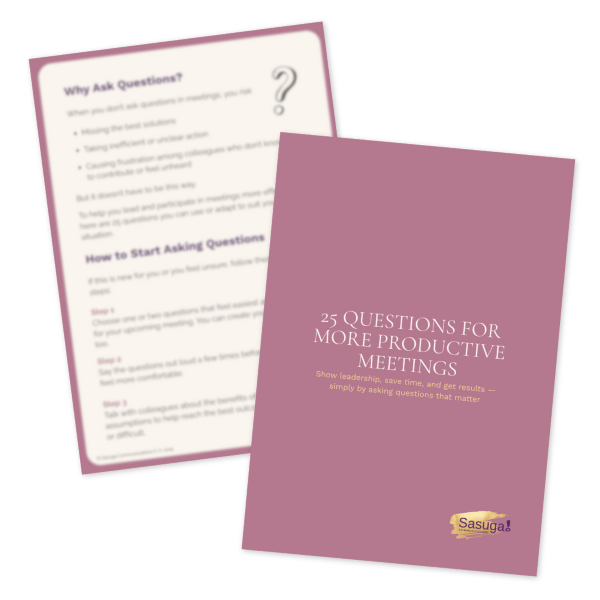
A free resource to help you ask meaningful questions
One of the most effective ways to improve both your listening and your meeting outcomes is to ask more questions—strategic questions. If, like many people, you find that difficult, I’ve created a free resource to help.
It’s called 25 Questions for More Productive Meetings—25 practical questions in English and Japanese to help you lead or participate in meetings more effectively, plus five easy steps to get started, even if asking questions doesn’t feel natural yet.
Ready to go deeper?
If this resonated and you’d like to explore how communication coaching or training could support you or your team, I’d love to hear from you.

Don’t miss the next post
This is the first in a five-part series celebrating the 10th anniversary of my book 英語の仕事術 (Eigo no Shigoto-jutsu), published with Shogakukan, covering listening and questioning, presentation skills, online calls, meeting facilitation, and dealing with workplace conflict.
To make sure you don’t miss a post, sign up for Sasuga! Tips For You—my free newsletter with practical techniques and inspiration in English and Japanese.
Other ways to enjoy this content
LISTEN on Apple Podcasts
LISTEN on Spotify
WATCH on YouTube
READ in Japanese
Frequently Asked Questions
What is the difference between hearing and listening?
Hearing is passive and automatic — as long as your ears are working, sound enters and you hear. Listening is active and intentional. It requires curiosity and the genuine desire to understand, not just to receive sound.
Why do professionals in global teams often miscommunicate?
Miscommunication usually happens not because of vocabulary or grammar, but because of assumptions. When we think we’ve understood, we stop checking. The gap between what was said and what was understood is where most workplace problems begin.
Why do Japanese professionals often avoid asking questions at work?
Two main reasons: the traditional educational environment encourages listening rather than questioning, and many professionals aren’t confident their English is strong enough to ask clearly. Both are understandable — but the cost of not asking is almost always higher than the discomfort of asking.
What are open and closed questions in business communication?
A closed question can be answered with yes or no — useful for confirming facts. An open question invites a fuller response and is essential for checking understanding. “Do you understand?” is closed. “What’s your first step going to be?” is open — and far more revealing.
How can I improve my listening skills in international meetings?
Notice which mode you’re in — hearing or listening, waiting to reply or genuinely wanting to understand. Ask more open questions. And remember: one small shift in awareness can change the quality of every conversation.