
How to run effective meetings in global teams—while respecting Japanese cultural norms
この記事の日本語版はこちら
What do you find most frustrating about meetings? Too many of them? They go off topic? It’s difficult to reach decisions? Some people talk too much? Others never say a word?
Well, dear reader, the good news is this post is like a mini masterclass of facilitation techniques to help you solve most—if not all—of the problems you face in meetings.
We’ll cover
- What most people get wrong when they make an agenda—and why it wastes time
- The 6 roles you need for effective meetings, no matter how many are in the room
- How to make it safe (and encouraged) to have a different opinion in Japan
- The single mistake that makes it hard to reach a group decision (and how to avoid it)
When I run facilitation skills workshops, I ask participants to list typical meeting problems. I’ve seen groups easily come up with 40 in just a few minutes. Before reading on, why not take a moment now to jot down your own list? Then compare with the list below.
40 typical meeting problems
- No clear agenda
- No clear goal
- Starts late
- Ends late
- Could have been shorter
- Wrong people in the room
- Key people missing
- Too many people
- One person talks the whole time
- Quiet people never speak
- People talk over each other
- Side conversations
- Someone hijacks the agenda
- Goes completely off-topic
- No one makes a decision
- The same decision gets revisited every meeting
- Decisions made—then ignored
- No clear next steps
- No one knows who’s responsible for what
- No follow-up after the meeting
- Meeting could have been an email
- Status updates that nobody needed to hear live
- Presenter reads directly from the slides
- Slides no one can read
- Tech problems waste the first ten minutes
- People joining late
- People leaving early
- Phones on the table
- Laptops open, attention elsewhere
- People multitasking visibly
- The HiPPO effect—highest paid person’s opinion wins
- No one challenges bad ideas
- Groupthink—everyone agrees too easily
- The real conversation happens after the meeting
- Minutes never arrive
- Minutes arrive three weeks later
- Minutes don’t reflect what was actually agreed
- A meeting to prepare for another meeting
- A meeting to debrief the last meeting
- People too exhausted to really contribute
How many of these did you recognize?
The cost of inefficient meetings
In 2024, research by Asana found that workers in Japan lose an average of 8.3 hours a week to unproductive meetings. That’s more than a full working day, every single week.
And think about what that means—not just in terms of everyone’s time, but also their frustration and stress levels.
It’s now so easy to meet, whether in person or online, and this seems to have led to an increase in meetings without much attention paid to whether everyone’s time is being used wisely.
So let’s start with a crucial question to change that.
Do you have a facilitator?
The word “facilitate” comes from the Latin “facilis,” meaning “easy.” A facilitator’s role is to make it easy for participants to achieve the meeting goals.
Below are three Facilitation Keys—Goals, Roles, and Ways—to deal with typical meeting problems, whether you’re in person or online, a small or large group, and 日本語での会議でも使えます。
Facilitation Key #1: Goals
The first key is to clarify the meeting goals.
You might be thinking, “Oh, but Helen, we circulate an agenda by email in advance, so the goals are clear.”
But are they?
Typical Meeting Agenda Example
Monthly Meeting, Thursday 2–3pm
Agenda
- Opening remarks
- Update from each team member
- Product promotion
- Discussion of current projects
- AOB
- Close
Look at a recent agenda from one of your meetings. Does it specify the goals? Or is it a list of topics like this one?
If goals aren’t specified (hint: you probably at least need a verb), meeting participants can make different assumptions about what’s expected. For example, if the agenda says “Product promotion,” participants could interpret the goal as:
- announce the plan for product promotion?
- identify challenges related to promoting the product?
- confirm sufficient resources to promote the product?
- agree on an idea to promote the product?
- brainstorm 10 ideas to promote the product?
When participants have different interpretations of the goal, they easily go off track—and can feel frustrated with each other too. This is especially the case in the high-context communication culture of Japan, where vagueness is so widely accepted. Have you experienced that?
Be clear about the goal to keep everyone aligned. For example, instead of just “Product promotion,” make it clearer: “Generate 3–5 ideas to promote the product and present to top management on Friday.”
Okay, so we’re clear on the meeting goals.
Facilitation Key #2: Roles
What role do you play in meetings? Is everyone in your meetings clear about their role, and how best to contribute to achieving the meeting goals?
Most meetings will benefit from six distinct roles:
- Facilitator: Helps participants achieve the meeting goals—makes it “easy,” as we talked about
- Note taker: Takes notes or minutes to help everyone remember what was agreed (it’s increasingly common to use an AI notetaker, but you need a human responsible for checking accuracy and making sure everyone receives the notes)
- Timekeeper: Helps everyone use the meeting time efficiently and finish punctually
- Contributor: Brings information, ideas, or opinions to help achieve the meeting goals (usually everyone in the meeting has this as one of their roles)
- Decision maker: Makes decisions in the meeting
- Challenger: Offers questions or suggestions to help participants consider different perspectives and achieve the meeting goals (may be known as the “devil’s advocate”)
Do you ever have meetings where the ultimate decision maker isn’t present? Even if that’s the case, you probably need to make some decisions in the meeting. (If not, do you really need a meeting? Could it be an email update instead, and save everyone’s time?)
If you don’t have a clear decision maker in the meeting, decision making becomes part of everyone’s role. It’s important to agree on how you’ll make decisions together—more on that in a moment.
Sometimes you have a natural Challenger in the room. These may be people you’ve found annoying in the past, because they always seem to be arguing against ideas or nitpicking. But having a Challenger is especially effective in Japan, where there’s a strong tendency toward harmony, avoiding conflict, and hesitating to voice a different opinion.
But not speaking up can lead to important information being missed. One of the best-known examples of a company suffering from not having an internal Challenger whose voice was heard was Kodak. Kodak developed the world’s first digital camera but shelved it to protect its lucrative film processing business. No one successfully challenged that decision internally, and what had been the world’s number one camera company eventually collapsed.
If you don’t have a natural Challenger, and it feels uncomfortable to assign one person, you can encourage everyone to adopt a “challenger mindset”—to think from different perspectives to get the best results.
As the facilitator, get agreement on who will take each of these six roles in your meeting. If you have fewer than six people, it’s fine for one person to have multiple roles. But make sure everyone has at least one role. If not—why are they there?
Facilitation Key #3: Ways
Even if you clarify the goals and roles of each participant, the conversation can easily go off track if the facilitator fails to align everyone on the ways you’ll get things done in the meeting.
Here are three examples of different ways to get things done.
Timing
How many times have you been in a meeting in Japan that overran? Or you spent a chunk of time on one topic and never got to the most important one?
You can make it easier to achieve the meeting goals—and save a lot of frustration—if you get agreement on roughly how long you’ll spend on each section of the meeting.
Of course, you may find that some topics need more time, and it’s then the facilitator’s role to get agreement to adjust the timing and keep everyone on track. More on that in a moment.
Brainstorming
Brainstorming is a common thing to do in meetings—to come up with ideas for initiatives or problem solving. What does brainstorming look like to you?
Did you know there are many different ways to brainstorm? For example, meeting participants might:
- take turns to give their ideas
- say their ideas as they think of them, in no particular order (this is sometimes called “popcorn style”)
- work in pairs to come up with ideas and then share with the group
- split into small groups and list ideas on a flip chart or whiteboard
- quietly write ideas on sticky notes and then stick them all on a wall—or in the chat for an online meeting
Consider which approach is best for your goal and your participants. Then propose one way to brainstorm and get everyone’s agreement. This keeps everyone focused and working efficiently.
Decision making
If you don’t have a decision maker in the meeting, you need to agree on how you’ll make decisions.
Do you decide by consensus (everyone has to agree) or by majority (more than half agree)?
Picture this. It’s almost the end of a long meeting and you need to decide on an action. Of the seven people in the meeting, five vote for action A and two vote for action B.
If you agreed at the start of the meeting that a majority vote is how you’ll decide, the two who voted for B will most likely accept this.
But if you didn’t get everyone’s agreement at the beginning, you may now have a frustrating and time-wasting conflict.
By now, you’re probably starting to recognize how much confusion, frustration, and wasted time you can avoid by clarifying the goals, roles, and ways to get things done.
Building small agreements: Propose, Clarify, Confirm
But things can still go wrong.
Here’s what makes all the difference. You don’t just say, “This is our goal, these are our roles, and this is the way we’re going to get things done.” It’s important to build small agreements as you go.
Imagine a rock climber. She hammers something called a piton into the rock for safety. Then if she slips and falls, she doesn’t fall all the way down—the piton catches her. She recovers and can climb back up again.
In the same way, when you build small agreements in a meeting, even if things start to go off track, you can refer back to the agreement and quickly realign.
Use these three simple steps to build small agreements around your Goals, Roles, and Ways.
Propose
For example: “I’d like to propose we spend around 25 minutes brainstorming ideas, 15 minutes narrowing them down to the top 3, and the final 10 minutes confirming what we’ve agreed and next steps.”
Clarify
Check for understanding to make sure everyone is aligned. “Any questions about this approach? Any other suggestions?
Confirm
Look around the room or the screen to check for agreement. You might want to add a summary of what was agreed, like: “So we’re agreed: 25 minutes brainstorming, 15 narrowing, 10 closing. Let’s go.”
That’s a piton in the rock. You’ve agreed on the process. Now, if the discussion gets heated or goes sideways, you can come back to what was confirmed and move forward from there.
Keeping the agenda and times visible on a whiteboard or in the online chat can be especially helpful.
Your 40 meeting problems, solved
Now, go back to your list of meeting problems from the start of this post. Next to each one, note which Facilitation Key—or keys—would help solve it. Sometimes more than one will apply.
To help, here’s that same list of 40 problems, with the Facilitation Keys that solve each one.
Facilitation Keys to solve 40 typical meeting problems
- No clear agenda → Ways
- No clear goal → Goals
- Starts late → Ways
- Ends late → Ways
- Could have been shorter → Ways
- Wrong people in the room → Goals/Roles
- Key people missing → Goals/Roles
- Too many people → Goals/Roles
- One person talks the whole time → Ways
- Quiet people never speak → Ways
- People talk over each other → Ways
- Side conversations → Ways
- Someone hijacks the agenda → Roles/Ways
- Goes completely off-topic → Ways
- No one makes a decision → Roles/Ways
- The same decision gets revisited every meeting → Ways
- Decisions made—then ignored → Ways
- No clear next steps → Ways
- No one knows who’s responsible for what → Roles/Ways
- No follow-up after the meeting → Roles/Ways
- Meeting could have been an email → Goals/Roles/Ways
- Status updates that nobody needed to hear live → Goals/Roles/Ways
- Presenter reads directly from the slides → Ways
- Slides no one can read → Ways
- Tech problems waste the first ten minutes → Ways
- People joining late → Goals/Roles/Ways
- People leaving early → Goals/Roles/Ways
- Phones on the table → Goals/Roles/Ways
- Laptops open, attention elsewhere → Goals/Roles/Ways
- People multitasking visibly → Goals/Roles/Ways
- The HiPPO effect—highest paid person’s opinion wins → Goals/Roles/Ways
- No one challenges bad ideas → Goals/Roles/Ways
- Groupthink—everyone agrees too easily → Roles/Ways
- The real conversation happens after the meeting → Goals/Roles/Ways
- Minutes never arrive → Roles/Ways
- Minutes arrive three weeks later → Roles/Ways
- Minutes don’t reflect what was actually agreed → Roles/Ways
- A meeting to prepare for another meeting → Goals/Roles
- A meeting to debrief the last meeting → Goals/Roles
- People too exhausted to really contribute → Goals/Roles/Ways
This is a lot, so I suggest picking the biggest problem you experience in meetings and testing out the technique that goes with it. How did it go? If you have a problem we didn’t cover, or a technique that didn’t work for you, drop me a message—let’s see if we can find a solution.
Thanks for reading.
Make it a brilliant and joyful day!
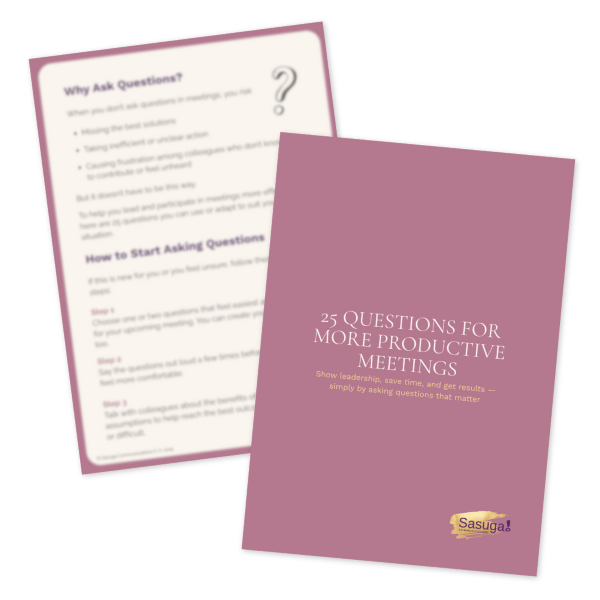 A free resource to help you lead better meetings
One of the most effective ways to improve both your credibility and your meeting outcomes is to ask more questions—strategic questions. If, like many people, you find that difficult, I’ve created a free resource to help.
It’s called 25 Questions for More Productive Meetings—25 practical questions in English and Japanese to help you lead or participate in meetings more effectively, plus five easy steps to get started, even if asking questions doesn’t feel natural yet.
Ready to go deeper?
If this resonated and you’d like to explore how communication coaching or training could support you or your team, I’d love to hear from you.
 Don’t miss the next post
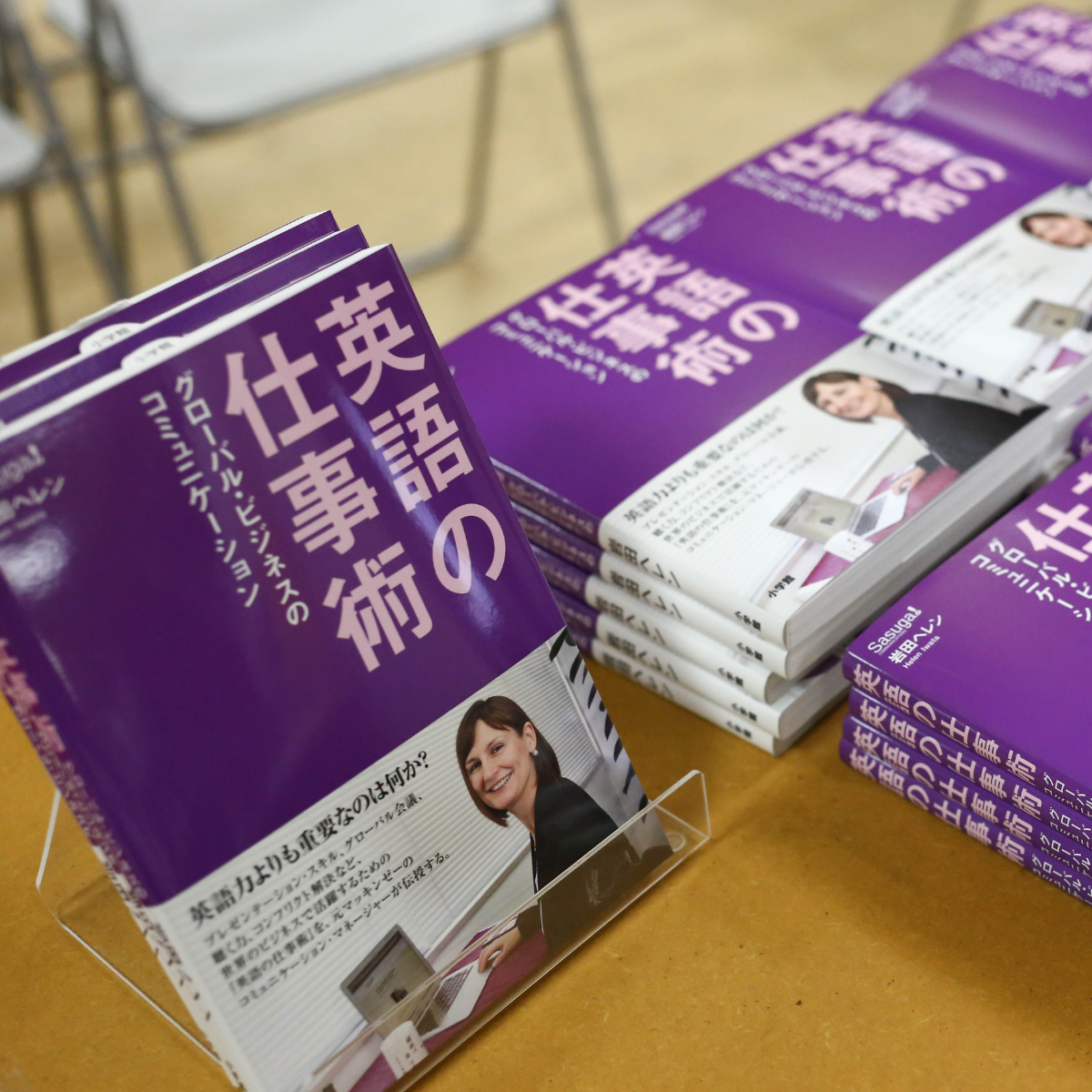
This is the fourth in a five-part series celebrating the 10th anniversary of my book 英語の仕事術 (Eigo no Shigoto-jutsu), published with Shogakukan, covering listening and questioning, presentation skills, online calls, meeting facilitation, and dealing with workplace conflict.
To make sure you don’t miss a post, sign up for Sasuga! Tips For You—my free newsletter with practical techniques and inspiration in English and Japanese.
Other ways to enjoy this content
LISTEN on Apple Podcasts
LISTEN on Spotify
WATCH on YouTube
READ in Japanese
Frequently Asked Questions
What are the three keys to facilitating an effective meeting?
The three Facilitation Keys are Goals, Roles, and Ways. Goals means clarifying the specific purpose of the meeting—not just listing a topic, but stating what you want to achieve. Roles means making sure everyone knows how they make a difference in the room. The six typical meeting roles are Facilitator, Note taker, Timekeeper, Contributor, Decision maker, and Challenger. Ways means agreeing on how you’ll get things done in the meeting, such as timing, brainstorming approach, and decision making.
Why do meetings go off track, even with an agenda?
Most agendas list topics, not goals. If a meeting item says something like “Product promotion” without specifying what needs to happen—whether that’s announcing a plan, brainstorming ideas, or confirming resources—participants can make different assumptions about the meaning. This mismatch is a common cause of meetings going off track.
What is the “Challenger” role, and why does it matter in Japan?
The Challenger offers questions or alternative perspectives to help the group consider angles or information it might otherwise miss—sometimes called the “devil’s advocate.” This role is especially valuable in Japan, where a strong tendency toward harmony and avoiding conflict can mean different opinions go unspoken. Kodak is a well-known example of what can happen when no one successfully challenges a flawed decision: the company invented the digital camera but shelved it to protect its film business, and ultimately lost its position as the world’s leading camera maker.
How do you make agreements in a meeting that actually stick?
Use the three-step framework: Propose, Clarify, Confirm. Propose a specific approach (not just “let’s discuss this”). Clarify by being open to questions or alternative suggestions. Confirm by checking agreement has been reached. These small agreements act like a rock climber’s pitons—if the discussion later goes off track, you can return to the last confirmed point and move forward from there.
In meetings, should you decide by consensus or majority vote?
Either can work—but it’s important to agree on which approach you’ll use before you need to make a decision. If a decision is split (for example, five votes for one option and two for another), people are far more likely to accept the outcome if they agreed to a majority decision in advance.
How important is English language capability for global business communication?
English language capability is less important that many people think for global business communication. You need enough vocabulary and basic grammar to get your message across. But beyond that, changing your nonverbal communication can have a much greater impact than attempting to learn a lot of sophisticated vocabulary or perfecting your grammar.
This post is part four of a five-part series celebrating the 10th anniversary of the book 英語の仕事術 (Eigo no Shigoto-jutsu) by Helen Iwata.
Read more here:
Part 1: The Listening Skill That Changes Everything at Work
Part 2: How to Start Any Presentation with Confidence—Even When You’re Nervous
Part 3: Four Online Meeting Mistakes That Damage Trust (And How to Fix Them)