Five Strategies to Respond—and How to Choose the Right One
この記事の日本語版はこちら
Do you ever have disagreements at work? Different ideas about a project, competing priorities, or a personality clash? Workplace conflict is everywhere—sometimes obvious, sometimes hidden. Either way, it can lead to a buildup of frustration and stress if it’s not addressed.
In this post, I’ll give you five practical strategies for handling workplace conflict, inspired by the Thomas-Kilmann Conflict Mode Instrument.
We’ll cover
- The 3 reasons workplace conflict is increasing and needs to be addressed
- How to recognize your “default” response to conflict and whether it’s the best approach
- The conflict strategy many people overuse (and why it can lead to burnout)
- When to compromise (and when not to)
Three causes of conflict
Before we get into the five strategies to respond to conflict, let’s look at 3 major causes of conflict at work.
1. Diversity
Diversity in the workplace is widely recognized as beneficial for innovative thinking. But it can also lead to more conflict because people with different backgrounds have different ideas about what is “common sense” and therefore make different assumptions.
2. Remote work
I wrote about how working remotely can increase conflict in my book Eigo no Shigoto-jutsu back in 2016 before working from home became common in the pandemic.
When teams work remotely, it’s harder for them to trust each other. People can’t see what others are doing. And when they communicate by email or chat, it’s easy to misread the intended tone of the communication and take things the wrong way. Misunderstandings easily lead to unnecessary conflict.
3. Increased workloads
Has your workload increased or decreased in recent years? Everyone I ask says they have more work today even though AI is supposed to help with efficiency. And the thing is that when the workload rises, in many cases, so does the stress. And when we’re under stress, our thinking narrows. We’re less likely to see things from someone else’s point of view. And we’re more likely to get into conflict situations.
Five conflict strategies
So to help deal with increasing workplace conflict, I’m going to give you five strategies. This is inspired by the Thomas-Kilmann Conflict Mode Instrument, a well-established model in conflict psychology.
This version uses animals to represent the different strategies, so that it’s easier to relate to and remember. I use it in corporate conflict workshops and participants love it because it gives them a common language and a playful, but still meaningful, way to talk more openly about conflict.
As I introduce these five animals, consider which is your usual conflict style.
1. SHARK = Fight (win-lose)
She fights for her opinion, knows she’s right, and won’t take no for an answer. This is a win-lose approach.
2. BEE = Collaborate (win-win)
Bees work together to find the best solution for everyone.
3. DOG = Accept (lose-win)
Picture a dog with wide eyes and a wagging tail. The Dog accepts whatever the person says or does.
4. OSTRICH = Avoid (lose-lose)
In many cultures, we have an image of the ostrich sticking her head in the sand. The idea is that if she can’t see, no one can see her. Apparently, this image isn’t well known in Japan, and it seems that ostriches don’t bury their heads in the sand. This is actually a misconception that is said to date back to ancient Roman times.
5. FOX = Compromise (50-50)
My parents in the UK sometimes see a fox in their garden. And our neighbors keep chickens. The fox steals the chicken eggs one by one. Foxes are often thought of as clever. And someone told me that they purposely don’t take all the eggs because they want some chickens to survive and lay more eggs. But it turns out this is another myth! It’s still a relatable representation of compromise, meaning that each side wins a bit and loses a bit.
So, dear reader, which is your normal response to a conflict situation? Do you fight, like the Shark, collaborate, like the Bee, accept what the other person says, like the Dog, avoid it, like the Ostrich, or compromise, like the Fox?
And which one would you say is the BEST strategy to respond to conflict?
Actually, any of them could be the best, depending on the situation.
When I first learned about this, it was a HUGE aha moment. And I’ll tell you why…
Let’s look at the matrix below.
How to choose your conflict strategy
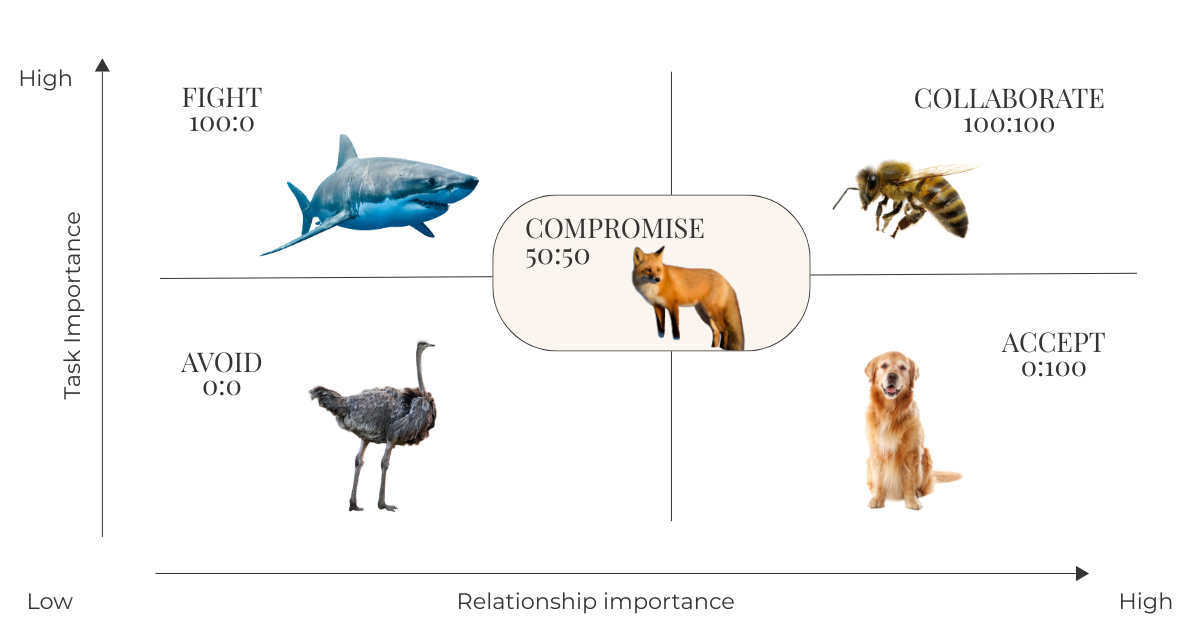
The vertical axis represents the importance of the task. And the horizontal axis represents the importance of the relationship.
So if the task is really important, but the relationship isn’t, the best strategy is to be a Shark and fight for it.
If both the task and relationship are important, the best strategy is to be a Bee and collaborate.
If the task isn’t so important, but the relationship is, the best strategy is to be a Dog and simply accept what the other person says.
And if neither the task nor the relationship is important, the best strategy is to be an Ostrich and avoid the conflict. Bury your head in the sand!
What about Fox in the middle? When do you compromise? This is the best strategy if you really want to collaborate, but you have a time constraint and can’t quite get to the win-win. You settle for 50-50, with each party getting something they want, but not everything they want.
Why collaboration isn’t always the best approach
When I first learned this matrix, I was shocked.
My default is collaboration. And I realized that in my corporate days, that was how I approached every conflict situation. I was a Busy Bee and wanted to find a win-win solution every time.
I poured far too much time and energy into attempting to keep everybody happy. It took me until my forties to realize that maintaining a great relationship with absolutely everyone, on absolutely everything, isn’t realistic—or wise.
No wonder I ended up with burnout. Twice!
Fortunately, I’ve now learned that while my natural tendency is to be a Bee, I can choose to use the other strategies where appropriate.
How about you?
I hope you can test out some new approaches to help you deal with workplace conflict more effectively.
Thanks for reading.
Make it a brilliant and joyful day!
Do you want to organize a conflict workshop for your team?
If you’re interested in a workshop to help your team understand and practice how to deal more effectively with conflict in the workplace or other leadership and communication challenges, contact Helen to explore what’s possible for your team.

Get Sasuga! Tips For You
If you found this post useful, you might enjoy my twice-monthly newsletter, Sasuga! Tips For You.
I share uplifting and practical stories, techniques, and resources to help you lead and communicate with more confidence in global business settings.
Other ways to enjoy this content
LISTEN on Apple Podcasts
LISTEN on Spotify
WATCH on YouTube
READ in Japanese
Frequently Asked Questions
What are the most common causes of workplace conflict?
Three factors are driving more conflict in today’s workplaces: diversity, remote work, and increased workloads. Diverse teams bring different assumptions about what’s “common sense,” which can lead to misunderstandings. Remote teams struggle to build trust and often misread tone in written communication. And as workloads rise, so does stress—making it harder to see things from someone else’s point of view.
What are the five strategies for handling workplace conflict?
Five strategies, inspired by the Thomas-Kilmann Conflict Mode Instrument, are Fight (Shark), Collaborate (Bee), Accept (Dog), Avoid (Ostrich), and Compromise (Fox). Each has its place depending on the situation—no single strategy is always right or wrong.
How do I know which conflict strategy to use?
Ask yourself two questions: How important is the task? And how important is the relationship? If both matter, collaborate. If the task matters more than the relationship, fight for it. If the relationship matters more than the outcome, accept. If neither matters much, avoid. And if you want to collaborate, but don’t have the time, compromise.
Is collaboration always the best response to conflict?
Not always. Collaboration produces the best outcomes when both the task and the relationship are important—but it takes time and energy. Applying a collaborative approach to every conflict, regardless of the stakes, can lead to exhaustion and even burnout.
What is the Thomas-Kilmann Conflict Mode Instrument?
The Thomas-Kilmann Conflict Mode Instrument (TKI) is a well-established model in conflict psychology that identifies five approaches to managing conflict. The animal-based framework in this post is inspired by the TKI and adapted to make the strategies easier to remember and apply in real workplace situations.
Why is workplace conflict increasing in global companies in Japan?
Global companies in Japan are navigating growing diversity, expanding remote and cross-border teams, and rising workloads—all of which create more opportunities for misunderstanding and friction. These trends were already emerging in 2016 and have accelerated significantly since the pandemic.
This the final post in a five-part series celebrating the 10th anniversary of the book 英語の仕事術 (Eigo no Shigoto-jutsu) by Helen Iwata.
Read more here:
Part 1: The Listening Skill That Changes Everything at Work
Part 2: How to Start Any Presentation with Confidence—Even When You’re Nervous
Part 3: Four Online Meeting Mistakes That Damage Trust (And How to Fix Them)
Part 4: Wasting Time In Meetings? Here’s Exactly How You Can Change That