

How to look and sound more confident on video calls—starting today
この記事の日本語版はこちら
Have you ever been in an online meeting and noticed someone’s forehead is all you can see? Or they seem to be looking at something in the corner of the room? Or their face is so close, you can practically count their pores?
Many business professionals want to make a good impression to colleagues, clients, or other key stakeholders, but they completely forget about how they come across on screen. Just because you’re not in the same room as the others… doesn’t mean they can’t see you.
In this post, I’m going to share four “mottainai moments” that happen in online meetings and presentations every single day—moments that could be costing you your credibility, your confidence, and the trust of the people you most want to impress. And if, like many of my clients, English isn’t your first language—英語の問題ではありません。This has nothing to do with your language skills.
Why faces matter more than you think
Before we get into the four mottainai moments, I want to share something that could completely change how you think about online meetings.
As babies, we spent a chunk of time lying in someone’s arms, gazing up at a face. And that face—those eyes looking back at us—that was everything. Connection. Safety. Love.
Our brains are wired to seek out faces. To read them, to decide whether we trust them and are willing to be influenced by them.
As humans, we see faces everywhere—even imaginary ones in the things around us—because our brains are constantly scanning for them. It’s called face pareidolia. In my workshops, I often show a classic example I found in my own kitchen. I was cutting a bell pepper in half and suddenly found a face looking back at me. Because of the shape of the holes, it clearly had two eyes and a mouth—and the seeds were lined up like teeth.

So when you show up on a video call—your face is the most powerful communication tool you have. Not your words. And if it’s positioned awkwardly, or your expression is unreadable—people notice. Sometimes consciously and definitely subconsciously.
Nonverbal communication is especially noticeable online because everything is happening inside that little rectangle of a screen. There’s more focus on it.
If you’re not using your nonverbal communication effectively, that’s “mottainai.” It’s a waste.
So let’s talk about the four mottainai moments—and what to do instead.
Mottainai Moment #1: Face position
Have you ever considered the ideal position for your face on screen?
You want your head to be roughly in the middle of the frame—with some space above your head—and your shoulders visible. Why the shoulders? Because people subconsciously read your posture to gauge your confidence. If they can only see your face, they’re missing part of the picture. When you’re talking with someone normally, you don’t just see the head. The neck and shoulders are within your view, right?
For lighting—you may have heard of ring lights. But for a normal business call, you don’t need to worry about anything fancy like that. Do check that people can see your face and read your expressions. If you have a window behind you, you may appear as a silhouette—which, frankly, is a bit creepy. Better to have some sort of light source in front of you, not behind.
Mottainai Moment #2: Eye contact
You’ve probably heard about the importance of eye contact. But there are differences in the appropriate level of eye contact depending on the culture. When I first started delivering presentation skills workshops in person in Japan, I would ask the audience if they wanted more or less eye contact from the presenter. Almost all the time, they wanted more. On rare occasions, someone was very shy and felt uncomfortable if the speaker looked at them a lot. The solution was to focus more on other participants.
In global business, eye contact is a sign of confidence that leads to connection, credibility, respect, and trust.
When we’re online, we naturally want to look at other people’s faces on the screen. But if you do that, it looks as if you’re looking down or to the side, depending on where the camera is located on your device. It means you lose connection with your audience.
The solution? Look directly into the camera—not at the screen. This is especially true when you’re making an important point or really want to connect. It’s fine to glance at the screen from time to time to get a sense of other people’s nonverbal communication or to check your slides. But most of the time you’re talking, you want to be looking into the camera.
Almost every time I tell my coaching clients this, they say it feels awkward. And they think it’s just them. It’s not—it’s completely natural that it’s uncomfortable because we’re not used to talking to a little green dot.
Some people find it helpful to stick a Post-it with a smiley face next to the camera on their device. Sounds simple—and it works.
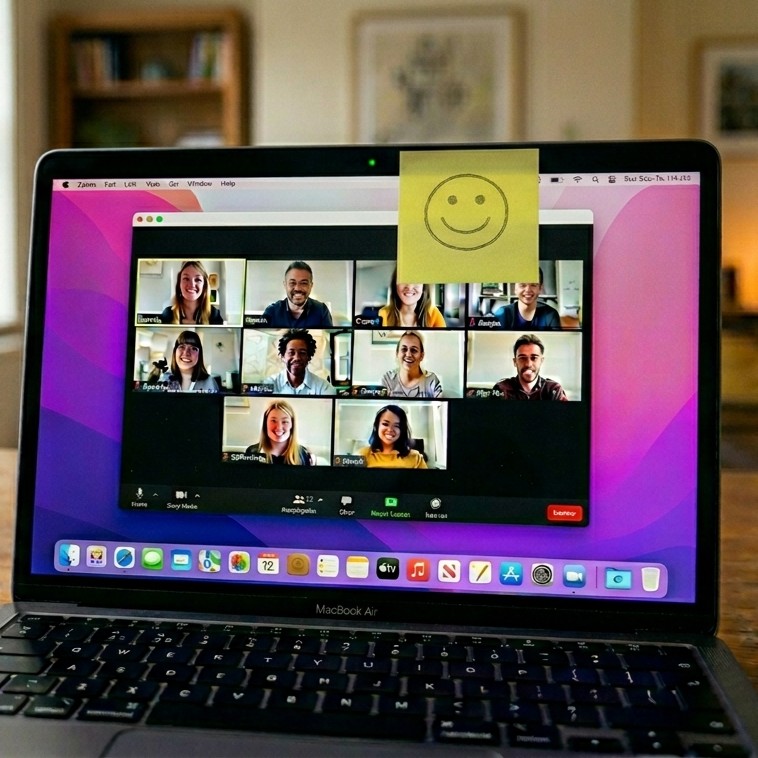
You also want to make sure the camera is at your eye level, so you’re not looking down on your audience—that can make them uncomfortable—or looking up at them—that makes you appear less confident. If you’re using a laptop, you can stack it on a box or some books. When I’m working from home, I find the adjustable height of my ironing board very handy.
Now that we’ve talked through these first two mottainai moments—your face and your eye contact—you’re probably starting to recognize just how much our brains evolved for face-to-face connection. Video calls are a workaround—a very useful workaround—but a workaround nonetheless. And that means we have to be more intentional, not less, about how we show up.
Technology that’s tackling these challenges for you
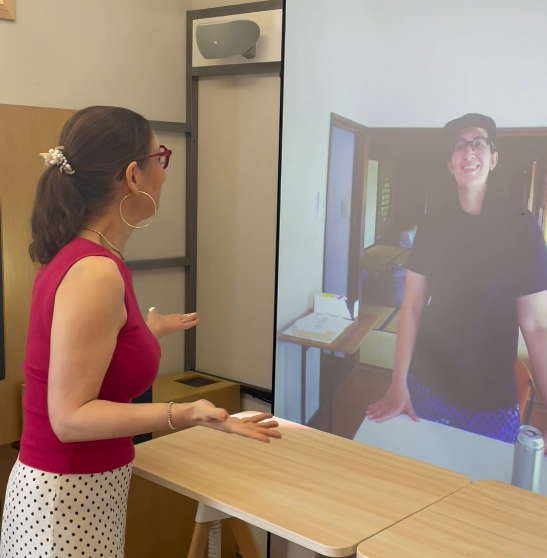
The other day, I had the opportunity to test out some amazing technology. It’s called tonari—which means “next door” in Japanese. Such a great name because it’s like having another room right next door.
It’s made possible with a floor-to-ceiling display that creates a portal, with the camera built in, so it’s like the other person is right in front of you and you can have normal eye contact.
Mottainai Moment #3: Slides and the dreaded laser pointer
For six years, I served as faculty for Tokyo University’s Executive Management Program. The Program Director, Yoshinori Yokoyama—who was also a former McKinsey Managing Director—had a pet peeve. He always said, “Helen, make sure they don’t do that.”
And “that” was something some people do for in-person presentations—but a lot of people do online, because it’s so easy…
…The dreaded laser pointer.
Picture a complex chart on screen—and a red dot whizzing around. The presenter knows where the pointer is. The audience— not so much. That whizzing red dot adds to the cognitive load of the audience, and some people say it actually makes them dizzy. It really doesn’t do anything for your credibility and can actually harm it.
The laser pointer is great for entertaining cats.

Seriously though—design your slides clearly enough that you don’t need a pointer. And guide your audience with your words.
“As you can see, starting from the left…”
“The chart on the right shows…”
Simple, clear direction—and your audience knows exactly where to look. Your voice is a far more reliable pointer than a wobbly red dot.
Mottainai Moment #4: Your hands
So we’ve talked about your head and shoulders, your eye contact, and slides—with the dreaded laser pointer. Now—have you thought about what to do with your hands when you’re speaking online?
You might think it doesn’t matter. Your audience can’t see them, right?
But you can use them to your advantage. As I mentioned in the first post of this series, from primitive times, our brains were wired to pay attention to movement in our environment—because movement could be a sign of danger. On screen, you don’t need to show the whole of your hands. But if there’s some visible movement—even subtle—it helps your audience stay engaged with what you’re saying.
You can adjust the amount of gesturing depending on your audience and the energy you want to bring. A more formal presentation with a senior Japanese audience—a little more restrained. A lively call with younger members of your global team—let it be a bit more expressive.
But no movement at all—a completely still talking head—does nothing to build engagement and makes it harder for people to stay focused. And if people aren’t engaged and can’t focus, they’re not likely to be impressed.
Your four mottainai moments—and what to do instead
- Face position: Head roughly in the middle of the frame, shoulders visible, light source in front of you.
- Eye contact: Look into the camera at eye level, especially when making an important point. A Post-It smiley face helps.
- The laser pointer: Guide your audience with clear slides and clear words. Save the laser pointer for the cat.
- Your hands: Use them. Movement keeps people engaged—especially on screen.
None of these take extra time or money. They just take awareness and the willingness to give it a go.
Thanks for reading.
Make it a brilliant and joyful day!
 A free resource to help you lead better meetings
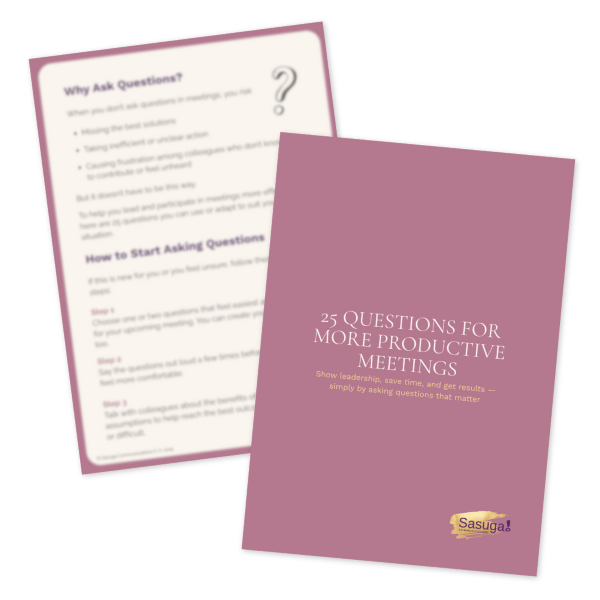
One of the most effective ways to improve both your credibility and your meeting outcomes is to ask more questions—strategic questions. If, like many people, you find that difficult, I’ve created a free resource to help.
It’s called 25 Questions for More Productive Meetings—25 practical questions in English and Japanese to help you lead or participate in meetings more effectively, plus five easy steps to get started, even if asking questions doesn’t feel natural yet.
Ready to go deeper?
If this resonated and you’d like to explore how communication coaching or training could support you or your team, I’d love to hear from you.
 Don’t miss the next post
This is the third in a five-part series celebrating the 10th anniversary of my book 英語の仕事術 (Eigo no Shigoto-jutsu), published with Shogakukan, covering listening and questioning, presentation skills, online calls, meeting facilitation, and dealing with workplace conflict.
To make sure you don’t miss a post, sign up for Sasuga! Tips For You—my free newsletter with practical techniques and inspiration in English and Japanese.
Other ways to enjoy this content
LISTEN on Apple Podcasts
LISTEN on Spotify
WATCH on YouTube
READ in Japanese
Frequently Asked Questions
Why does my camera make me look less confident?
Camera angle and positioning have a surprisingly big impact on how you come across online. If your camera is too low, too high, or your face is off-center, it can affect how confident and credible you appear—even if your words are excellent. The fix is simple: position your head roughly in the middle of the frame with your shoulders visible, and make sure the camera is at eye level.
How do I make eye contact on a video call?
On a video call, eye contact means looking directly into the camera—not at the faces on your screen. It feels unnatural at first because we’re wired to look at faces, but looking at the screen means you appear to be looking down or to the side because of the camera position on your device. A helpful trick: stick a Post-It with a smiley face next to your camera as a visual anchor.
Should I use a laser pointer when presenting slides online?
No—avoid it. The laser pointer is one of the most common credibility-damaging habits in online presentations. The red dot moves quickly and adds to your audience’s cognitive load, and some people find it disorienting or even dizzying. Instead, design your slides to be clear without a pointer, and guide your audience with words: “As you can see on the left…” or “The chart on the right shows…”
Do gestures matter on video calls?
Yes—more than most people realize. Our brains are wired to notice movement, so visible hand gestures on screen help keep your audience engaged. You don’t need to show your full hands—even subtle movement in frame makes a difference. A completely still talking head is harder to stay focused on.
What is a mottainai moment?
Mottainai (もったいない) is a Japanese word that expresses regret over waste—the feeling of “what a shame” when something valuable is being squandered. According to Leadership and Communication Coach Helen Iwata, a mottainai moment in communication is when you miss the opportunity to truly demonstrate your skills and expertise. The good news? Once you’re aware of your mottainai moments, they’re easy to fix.
How important is English language capability for global business communication?
English language capability is less important that many people think for global business communication. You need enough vocabulary and basic grammar to get your message across. But beyond that, changing your nonverbal communication can have a much greater impact than attempting to learn a lot of sophisticated vocabulary or perfecting your grammar.
This post is part three of a five-part series celebrating the 10th anniversary of the book 英語の仕事術 (Eigo no Shigoto-jutsu) by Helen Iwata.
Read more here:
Part 1: The Listening Skill That Changes Everything at Work
Part 2: How to Start Any Presentation with Confidence—Even When You’re Nervous